
Modern SOC teams operate under one core principle: Assume Breach.
To reflect on this reality, I built a realistic enterprise-style detection lab. This week I focused on one of the most common internal attack paths seen today:
RDP password brute forcing followed by Active Directory reconnaissance.
I created a local isolated environment in my Proxmox homelab, collected telemetry with Wazuh + Sysmon, and walked through both the attacker workflow and the SOC analyst investigation path
1. Lab Environment & Architecture #
My isolated enterprise-style lab contains:
- Windows Server 2022 — Domain Controller (Lab.local)
- Windows 11 Client 01 — domain-joined
- Windows 11 Client 02 — domain-joined
- Wazuh Server — SIEM, rules engine, and log analysis
- Kali Linux Attack Box — offensive tooling
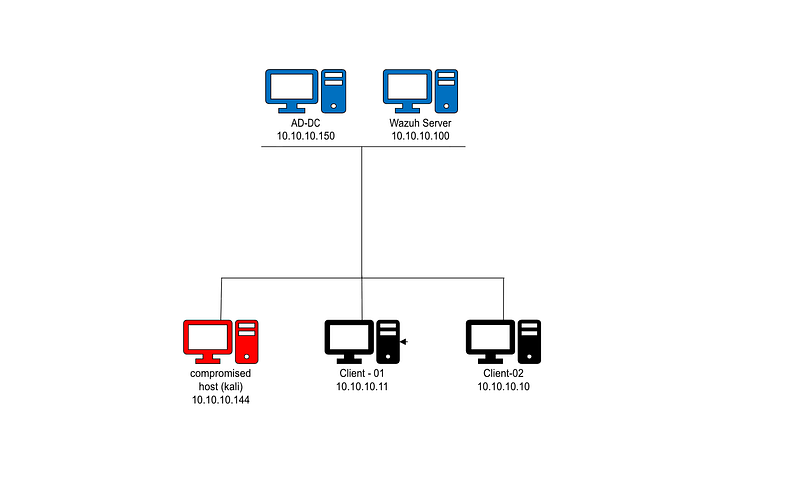
Lab Topology
Wazuh agents were deployed to all Windows hosts, collecting:
- Windows Security Events
- Rich Sysmon telemetry
- Authentication attempts
- Process creation and activity
2. Scenario: Assumed Breach → Internal Lateral Movement via RDP #
To keep the focus internal, we assume the attacker already controls an internal endpoint and has uncovered a domain user named “target”.
This scenario mirrors real incidents involving initial footholds like:
- compromised contractor laptops
- unmanaged BYOD devices
- post-phishing lateral movement
The attacker’s objective:
obtain valid domain credentials and move laterally to a Windows workstation using RDP.
3. RDP Password Brute Force (Hydra) #
From the Kali machine, I launched an RDP brute-force attack against the user “target” of CLIENT02 using Hydra:
hydra -l target -P wordlist.txt rdp://10.10.10.10This generated real attacker telemetry including:
- multiple failed logons (Event ID 4625)
- a single successful RDP login (Event ID 4624)
- Sysmon network connections to port 3389 (Event ID 3)
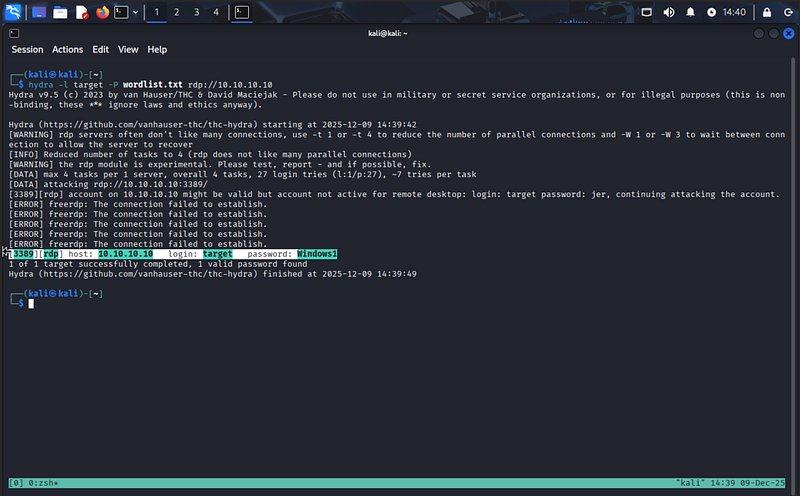
Hydra brute force of RDP successful
4. SOC Visibility & Wazuh Detection #
As soon as the brute force began, Wazuh generated correlated alerts.
Key Windows Security Events:
- 4625 — Failed RDP Authentication attempts
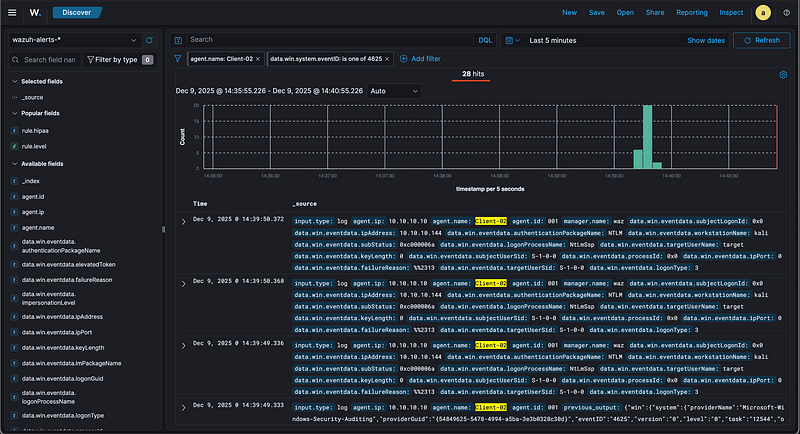
wazuh dashboard showing 28 failed login attempts captured
- 4624 — Successful RDP Authentication
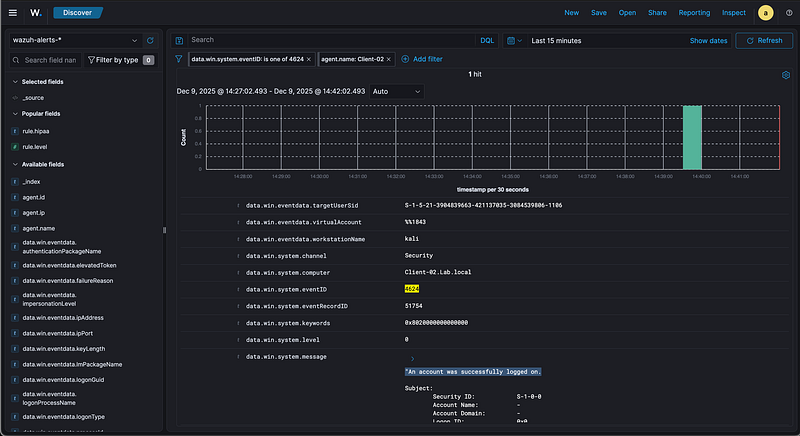
wazuh dashboard showing successful authentication event captured
Sysmon Events:
- 3 — RDP connection attempts (TCP 3389)
Wazuh Rules Triggered:
- rules level 5, 6, and 10
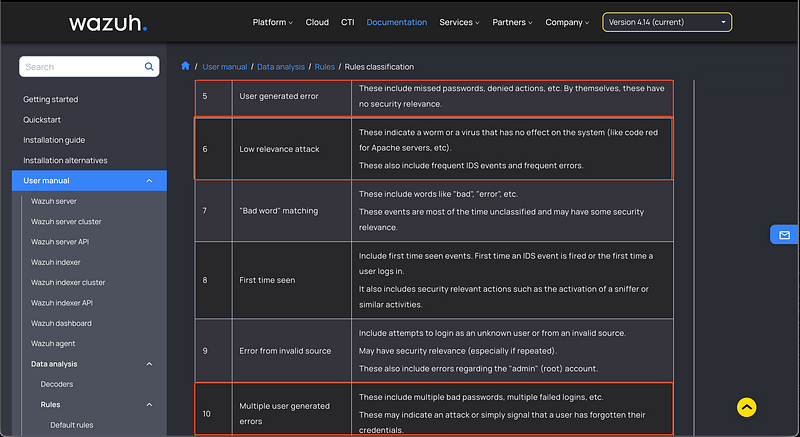
wazuh rule classification from documentation
- Excessive failed logon attempts
- Possible brute-force correlation
- When multiple failed authentication events occur within a defined time window, correlation rules with higher severity are triggered.
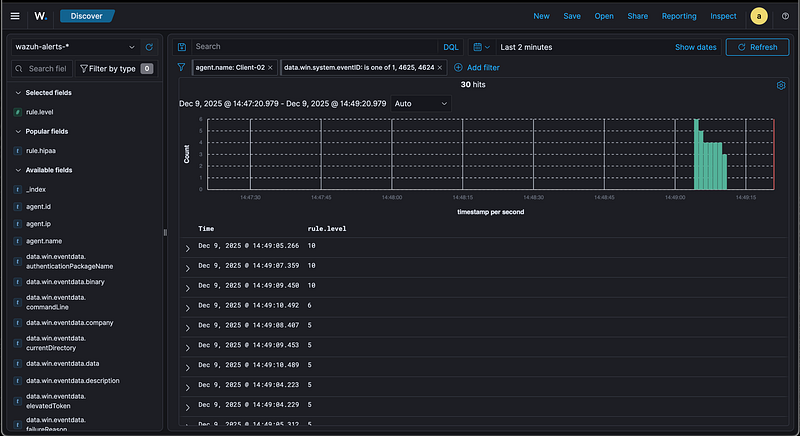
wazuh dashboard showing rules 5, 6, and 10 alerted
5. Post-Compromise Active Directory Recon #
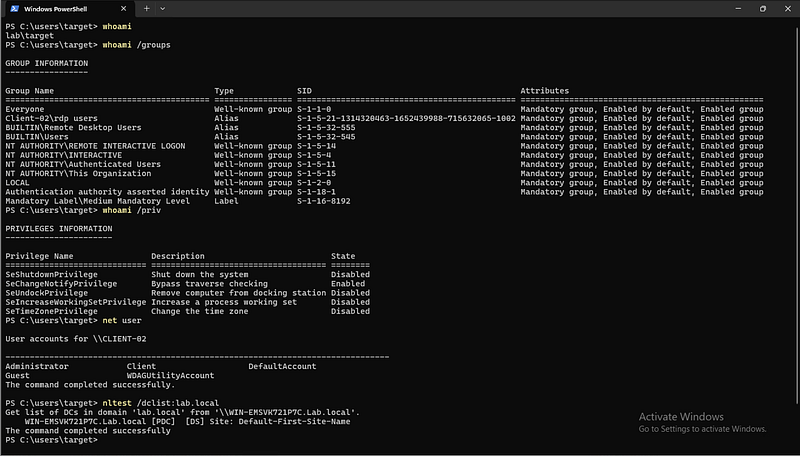
After successfully authenticating via RDP, I initiated early-stage domain enumeration mimicking what an attacker would do after moving laterally:
whoami
whoami /groups
whoami /priv
net user
nltest /dclist:lab.local
This type of recon helps an attacker understand:
- domain structure
- user/group membership
- possible escalation paths
- critical administrative targets
Wazuh captured:
- powershell process creation of net.exe
- user it was executed from
- exact commands attackers used
- possible malicious command alerted by rule.MITRE.technique: Account Discovery
- Sysmon telemetry tied to the attacker session
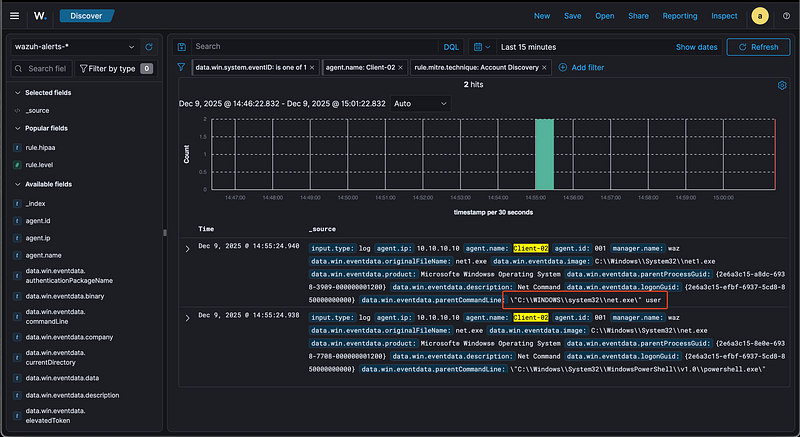
wazuh dashboard capturing account discovery technique alert from net command
6. Analyst Investigation: Correlating the Attack Chain #
I investigated the attack from a SOC perspective, correlating telemetry chronologically:
- Spike of Event ID 4625 (failed RDP logons setting off rule 10)
- A sudden successful 4624 interactive RDP login
- Logon Type 10 (remote interactive)
- New processes spawning under the compromised user from Active Directory reconnaissance commands
- Persistent RDP session activity
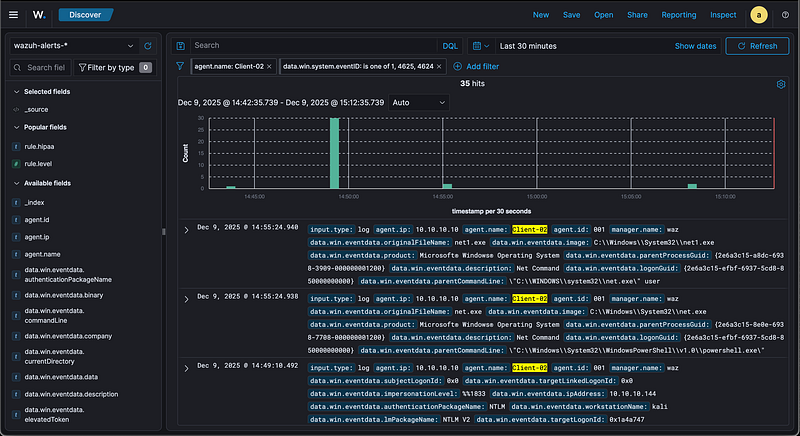
wazuh dashboard showing alerts generated for EVENT.ID 1, 4624 and 4625
7. Lab Takeaways #
- Visibility is everything. Internal attacks like RDP brute force often bypass perimeter defences, so host-level telemetry (Windows Events + Sysmon) is essential for seeing what actually happens inside the host. Sysmon enables rich telemetry that gives our soc much more visibility.
- SOC teams rely on correlated signals, not isolated events. When Wazuh ties together 4625 failures, a successful 4624, and Sysmon network activity, the full story of lateral movement becomes clear.
- Internal recon is easily detectable with the right logs. Enumeration commands leave reliable, high-value artifacts that help analysts confirm malicious behavior quickly.
- Effective SOC detection comes from tuning, not tools alone. Well-configured rules turn raw logs into actionable, high-confidence alerts.
- We cannot protect what we cannot see